Tag Archives: Eschatology

The Translation of Enoch and the Rapture of the Church

In His Olivet Discourse, Jesus said, “But as the days of Noah were, so shall also the coming of the Son of man be” (Matt24:37). The Flood of Noah is a type of the coming Tribulation period (i.e., Daniel’s 70th Week). Noah and his family, who endured the judgment of the Flood on earth, but were Divinely preserved through it, are a type of the nation of Israel; Israel will endure the judgment of the Tribulation on earth, but will be Divinely preserved through it (Zech13:8-9; Rev12:6,14). In contrast, the translation of Enoch from earth to heaven (without dying; Gen5:24; Heb11:5) is a type of the pre-tribulational rapture of the Church (1Thess4:15-17; Rev4:1-2); the Church will be supernaturally removed from the earth before the judgment of the Tribulation begins (Luk21:36; 1Thess1:10; Rev3:10). In the translation of Enoch prior to the Flood, only a single person was removed from the earth; in the rapture of the Church prior to the Tribulation, the singular Body of Christ (i.e., the “one new man”; Eph2:15) will be removed from the earth (1Cor12:27; Eph1:22-23). Note also that Enoch was supernaturally translated from the earth to heaven, whereas Noah had to build an Ark according to God’s revealed specifications in order to be saved from the Flood; this comports with the fact that the Church will be raptured according to grace, whereas Israel was required to keep the Law delivered by God through Moses (Cp., Jn1:17).

Note that there was a gap of time between the translation of Enoch and the beginning of the “days of Noah”; from the translation of Enoch to the birth of Noah was 69 years. Since the “days of Noah” correspond typologically to the Tribulation, this observation is consistent with the expectation that there will be a gap of time between the rapture of the Church and the beginning of the Tribulation (i.e., the rapture is not the event that begins the Tribulation; cf. Dan9:27). However, to conclude that there will be 69 years between the rapture of the Church and the beginning of the Tribulation is almost certainly pressing the type too far; whereas the Flood was a type of the Tribulation, it lasted only slightly more than a year (not 7 years), and the “days of Noah” were 950 years (Gen9:29).

While the 69 year gap between the translation of Enoch and the beginning of the Flood likely has no literal connection to the gap of time between the rapture of the Church and the beginning of the Tribulation, it may yet be found to have a typological significance.


Who Are the Many?

The adjective/pronoun “many” occurs hundreds of times in the Bible, both Old and New Testaments. In the vast majority of those instances, the immediate context makes clear to whom/what “many” refers. However, there are a small number of important instances in which there is no definite referent for “many” (e.g., Dan8:25; 9:27; 11:14,18,26,33,34,39; 12:10; Matt19:30; 20:16; 20:28; 22:14; 26:28; Mk10:31,45; 14:24; Luk14:16); it should be noted that these instances tend to occur primarily in the O.T. and the synoptic Gospels, whose focus is the nation of Israel under the Dispensation of Law. In these instances, the “many” refers to Israel. For a study of this issue, see the article Who Are the Many? Under the Biblical Studies tab.


The Pre-Trib Rapture is the Sign

To the question of His disciples, “And what shall be the sign of thy coming” (Matt24:4), Jesus responded with the Olivet discourse (Matt24:4-41; Mk13:5-37; Luk17:26-37) in which He gave an expanded recounting of Daniel’s 70th Week (Dan9:27; which would be greatly expanded by the Apostle John in Revelation 6-19).  This recounting, as recorded by Matthew and Luke, ended with an allusion to a mysterious disappearance.  Jesus said, “I tell you, in that night there shall be two men in one bed [i.e., night]; the one shall be taken, and the other shall be left.  Two women shall be grinding together [i.e., morning]; the one shall be taken, and the other left.  Two men shall be in the field [i.e., afternoon]; the one shall be taken, and the other left” (Luke 17:34-36).

Dispensationalists have long disputed the proper understanding of Matthew 24:36-42 and Luke 17:26-37 which relates a future event in which a multitude of persons around the world instantaneously disappear.  On its face, this event would seem to correlate with the Rapture of the Church (cf. 1Cor15:51-52; 1Thess4:13-17), yet the majority of Dispensationalists, especially those adhering to the revised Dispensationalism of Walvoord, Ryrie, and Pentecost, have argued that the Rapture of the Church has no logical place in Jesus’ Olivet discourse.  Rather, the Olivet discourse pertains only to the nation of Israel and has nothing to do with the Church, which at that time had not yet been revealed.  While it is admitted that the birth of the Church had not yet taken place, nor does Jesus refer to it by name, He most certainly referred to its Rapture at the end of the Olivet discourse.

Jesus’ Olivet discourse is not about the Church; rather, it is a message to the nation of Israel.  But its subject concerns the “sign” for which the nation of Israel should “watch” (cf. Matt24:42; Mk13:33-37) in order to know that the second “coming” of Christ is near (cf. Matt24:4).  While Jesus gave numerous signs throughout the discourse (e.g., “wars and rumors of wars”, “pestilences”, “earthquakes”, “the abomination of desolation”, and “false Christs, and false prophets”), He concluded the discourse with the ultimate “sign”; it is the “sign” that precedes all the other signs, and one which cannot possibly be missed by the nation of Israel (and the world), which is the unexpected, sudden, and instantaneous disappearance of a multitude of persons all around the world.  It awaited the writings of the Apostle Paul to fully reveal the doctrine concerning the Rapture of the Church which ends the parenthetical Dispensation of Grace, a temporary pause in God’s prophetic program for the nation of Israel, but the Lord Jesus most certainly pointed to the event as the “sign” to the nation of Israel that the return of Christ was drawing near.

The moment after the Rapture of the Church, no believer will remain on earth.  And yet, 144,000 Jews will be converted and used by God to evangelize the whole world during the Tribulation (cf. Matt24:13; Mk13:10; Rev7:1-17).  How are these Jews converted?  Might not the sudden disappearance of millions of people around the world, for which Jesus exhorted the nation of Israel to watch, be the “sign” that triggers the conversion of the 144,000? Maranatha!


Interpreting Scripture

Covenant (Reformed) Theology and Dispensational Theology have long debated the proper hermeneutic to use when interpreting Scripture.  While both use a literal method for much of Scripture, Dispensationalism (especially so-called Revised Dispensationalism under Charles Ryrie) has emphasized the consistent use of literal interpretation for all of Scripture.  This is seen most clearly in that both Dispensationalism and Covenant Theology interpret historical narratives literally, whereas Covenant Theology often interprets prophetic passages of Scripture allegorically.  Forgotten in this discussion is that Classical Dispensationalism as developed under the Plymouth Brethren, Scofield, Chafer, and especially Arno Gaebelein, while not denying the literal historicity of historical passages, also allowed for a typological understanding of them (see the CHART: Philosophies of Interpretation under the Biblical Studies tab).  They viewed many of the Bible’s historical accounts as establishing patterns having prophetic significance (cf. Eccl1:9-10; 3:15; Cp., Rom5:14; Col2:17; Heb8:5; 10:1; 11:19).  Indeed, the Apostle Paul affirmed that O.T. historical accounts “were written for our learning, that we, through patience and comfort of the scriptures, might have hope” (Rom15:4), and that “all these things happened to them for ensamples, and they are written for our admonition, upon whom the ends of the world are come” (1Cor10:11).  The word translated “ensamples” is from the Greek tupos (i.e., types). Typology is a rich and fruitful feature of Scripture that should not be neglected!


The Identity of the 24 Elders

In Revelation 4:4, “four and twenty elders” are seen by the Apostle John sitting on “four and twenty [thrones]” in heaven.  The identity of these 24 elders has long been debated.  However, most Dispensationalists have traditionally held that the 24 elders represent the completed Church (i.e., the Body of Christ).  If that view is correct, the completed Church is in heaven before the 7-year Tribulation (i.e., the 70th Week of Daniel; Dan9:27) begins in Revelation 6, which all but necessitates a pre-tribulational rapture of the Church; such a conclusion is seemingly inescapable.  Hence, the correct identification of the 24 elders is pivotal to a proper understanding of the chronological sequence of eschatological events. A systematic analysis of the Identity of the 24 Elders can be found under the Biblical Studies tab.


Why Were the Thessalonians Shaken?

The second chapter of Paul’s second epistle to the Thessalonians is a mighty tour-de-force polemic for the pre-tribulational nature of the rapture of the Church.  It has long been recognized that the Restrainer of 2 Thessalonians 2:7 is the Holy Spirit, and that His removal before the Antichrist is revealed (i.e., before the Tribulation begins) necessitates the rapture of the Church due to the Spirit’s indwelling of the Body of Christ as a temple in the present dispensation (1Cor6:19).  It has more recently been recognized that the “falling away” in 2 Thessalonians 2:3 (KJV; Greek, apostasia) that also must occur before the Antichrist is revealed is in context better understood to be a departure (i.e., the rapture of the Church).  However, even without these clear and powerful witnesses, a pre-tribulational rapture of the Church is a necessary inference from Paul’s opening to the chapter in 2 Thessalonians 2:1-2.

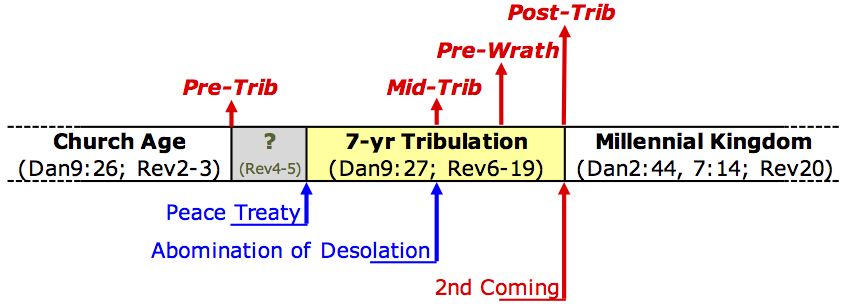
FIGURE 1. Timing of the Rapture in the Pre-Trib, Mid-Trib,
Pre-Wrath, and Post-Trib Views.

In 2 Thessalonians 2:1, Paul introduces the subject of the chapter as “the coming of our Lord Jesus Christ, and our gathering together unto him”.  The subject is a single event, since the first substantive clause is articulated and the second is not, being connected by an epexegetical kai in the Greek text (i.e., the Granville Sharp rule).  Paul’s subject is that particular “coming of our Lord Jesus Christ” which involves “our gathering together unto him” (cf. Jn14:1-3; 1Thess4:13-18). Thus, the subject of the chapter is the rapture of the Church.

In 2 Thessalonians 2:2, it is revealed that the Thessalonians had become “shaken in mind” and “troubled”, apparently as a result of a “letter as from us” (i.e., a letter alleging to be from the Apostle Paul, which was in fact a forgery). Their alarm was caused by the fact that the letter asserted that “the day of the Lord” had begun. The remainder of the chapter presents an iron-clad polemic for why that could not possibly be the case. However, one must ask why this news so disturbed the Thessalonians; why were the Thessalonians shaken?

In 2 Thessalonians 2:5 Paul reminds the Thessalonians that he had previously instructed them concerning this subject. Indeed, Paul’s first epistle to the Thessalonians discusses the rapture in every chapter (cf. 1Thess1:9-10; 2:19; 3:13; 4:13-17; 5:1-11). Presumably Paul had taught them when the rapture would occur relative to the coming 7-year Tribulation (i.e., the day of the Lord; 2Thess2:2). If he had taught them that the rapture of the Church would occur mid-trib, pre-wrath, or post-trib (i.e., any view that sees the rapture of the Church as occurring at some point during the Tribulation; see FIGURE 1), there is no reason for the Thessalonians to be “shaken” or “troubled”. There would be no inconsistency between those rapture views and the counterfeit message alleging that the Tribulation had begun. Rather than causing them to be “shaken”, such news would be cause for excitement and anticipation, since it would mean that their rapture was necessarily drawing near. However, if Paul had taught the Thessalonians that the rapture of the Church would occur before the Tribulation begins (i.e., pre-trib), then it is easily understandable why news that it had begun would be so troubling; if true, it would mean either: 1) that Apostle Paul’s previous teaching was untrue, or 2) the rapture of the Church had already occurred, and they had been left behind.

Only a belief in a pre-trib rapture as taught to the Thessalonians by the Apostle Paul explains why they were so “shaken” and “troubled” by the counterfeit message that the day of the Lord (i.e., the Tribulation) had begun. No other rapture view would have troubled the believers at Thessalonica. Properly understood, 2 Thessalonians 2:1-2 is a powerful witness to the fact that the Apostle Paul taught that the rapture of the Church would be pre-trib!


Dispensationalism’s Necessity of a Pre-Tribulational Rapture

A proper dispensational understanding of the Bible (2 Timothy 2:15) absolutely necessitates a pre-tribulational Rapture of the Church.

What is the Church? The Church is being formed during the present Dispensation of Grace and is comprised of all who believe, whether Jew or Gentile, who are subsequently baptized into the Body of Christ (1 Corinthians 12:12-13). Furthermore, the Church is not (the nation of) Israel, or any other nation, but a unique body comprised of believers from all nations. However, if the Church is present on earth during the Tribulation period (i.e., the 70th Week of Daniel; Daniel 9:27), all who believe during the Tribulation must become members of the “Church”. If this is to be the case, there can be no “saved” nation of Israel or Gentile nations present on earth at the end of the Tribulation to enter the Millennial Kingdom.

Utter confusion results if the Church is present on earth during the Tribulation. But thanks be to God, who has promised to remove the completed Church, the Body of Christ, at the Rapture (e.g., 1 Thessalonians 1:10; 2 Thessalonians 2:3; Revelation 3:10). During the Tribulation, the Church will be wed to Christ in heaven (Revelation 19:7-8), and those on earth who believe and endure to the end make up the “saved” nations who enter the Millennial Kingdom at the second coming of Christ.


The Answer to Preterism

“Verily I say unto you, This generation shall not pass, till all these things be fulfilled.” (Matthew 24:34)

Based on this verse, Preterists conclude that the 70th Week of Daniel must have occurred within the lifetime of those hearing this prophecy spoken by Jesus; thus, it took place in the 1st century and is a past event from our present point of view. Matthew 10:23 and 16:28 present similar challenges that are resolved within Preterism by placing the fulfillment of prophecy in the 1st century AD.

However, the tension created by Matthew 24:34 is not resolved by conceding that its prophecy was fulfilled in the past. Such a solution creates more problems than it solves, since it is self evident that the 2nd Coming of Christ (as described in the Bible) did not occur in the 1st century. Rather, the tension is revolved by the two-fold recognition of:  1) the contingent nature of the Kingdom, and 2) the mystery nature of the Church (Age).

A study of this issue, titled Answer to Preterism, has been added under Biblical Studies.


Not Apostasy, But Rapture!

Paul’s second epistle to the Thessalonians was written as a response to a query that church had sent to the Apostle. The Thessalonians were troubled by a letter they had received, purportedly from Paul (but actually a forgery), alleging that they had entered into “the day of the LORD” (2Thess2:2). They were troubled by this since Paul had previously taught them that the rapture of the Church would happen before the outpouring of God’s wrath during the Tribulation period (1Thess4:13-5:9); if this allegation were true, and the day of the LORD had indeed begun, that meant the believers in Thessalonica had been left behind! It should be noted that the believers in Thessalonica were undergoing intense (albeit local) persecution (1Thess3:2-4), so that it was no doubt tempting for them to believe that the Tribulation had begun.

Paul’s reply was to immediately remind them of what he had previously taught them (2Thess2:5); namely, that the Antichrist cannot even be “revealed”, which begins the Tribulation (Dan9:27), until after an event he calls “the falling away” (2Thess2:3). The Greek noun translated “falling away” is apostasia, transliterated as ‘apostasy’ in some English versions. The correct translation of apostasia is ‘departure’; exactly what kind of departure is in view depends upon context, and can just as likely mean a physical departure as it does a departure from the faith (i.e., apostasy). It is interesting that all English translations before the KJV rendered apostasia in 2 Thessalonians 2:3 as “departure”, whereas the KJV and most subsequent translations render it “falling away” or something which similarly implies the ‘departure’ is religious in nature. There is nothing in the context of 2 Thessalonians 2, however, that demands (or even suggests) that the departure to which Paul refers be non-physical.

Furthermore, in the Greek text there is the definite article in conjunction with apostasia, so that the best translation is not “a falling away”, but “the departure”. The use of the definite article means that Paul is referring to a specific event that he expects is already known to the Thessalonians. Since Paul’s first epistle to them included the most detailed revelation of the rapture of the Church in the N.T., and in fact mentions the rapture in every chapter (1Thess1:9-10; 2:19; 3:13; 4:13-17; 5:1-11), while not one reference to a religious apostasy or departure from the faith occurs, context demands that the specific departure to which Paul refers is the rapture. The context of 2 Thessalonians 2 also supports this, since the rapture, referred to as “the coming of our Lord Jesus Christ, and our gathering together unto him”, introduces the chapter (2Thess2:1). Thus, the evidence is overwhelming that the departure Paul holds out as necessarily taking place before “the day of the LORD” and the revealing of the Antichrist is the rapture of the Church. Thus, 2 Thessalonians 2:3 is the most explicit teaching of the Pre-Trib rapture in the Bible.


Signs of the Second Coming

“And what I say unto you, I say unto all, Watch.” (Mark 13:32-37)

The Lord Jesus rebuked the Pharisees and Sadducees for failing to recognize the signs of His First Coming (Matthew 16:1-3). Obvious signs they should have recognized included: 1) the virgin birth in Bethlehem (Isaiah 7:14; Micah 5:2; Matthew 2:1-12; Luke 1:26-35; 2:1-14), 2) prophesied Messianic miracles (Isaiah 61:1-2; Luke 4:16-21), and 3) Daniel’s prophecy of the 69 Weeks which gave the very day Messiah would present himself to Israel (Daniel 9:25; Luke 19:41-44).

During His ministry at His First Coming, Jesus taught there would also be signs that precede His Second Coming (Matthew 24:3ff; Luke 21:25-28). For these signs (Mark 13:4), Jesus commanded us all to “Watch” (Mark 13:32-37).

A new study titled Signs of the Second Coming has been added under Biblical Studies.